
Ask Barbie: Which has the Higher Risk of Causing Blood Clots:
Oral Estrogen or Transdermal Estrogen?

Oral Estrogen or Transdermal Estrogen?
Welcome to “Ask Barbie,” where I answer all your burning questions about menopause. Today’s question is, “Which has the higher risk of causing blood clots: Oral estrogen or transdermal estrogen?”
Now this question taps into five separate issues. They are:
So, I’ll answer the question by addressing all five issues.
Somehow, estrogen gets all the blame for everything. But estrogen is not the only sex hormone that can cause blood clotting. All the sex hormones can cause blood clotting: estrogen, progesterone, and testosterone. So do not isolate estrogen as the bad guy.
All the sex hormones have the same basic chemical structure. It is this basic chemical structure that increases risk for blood clotting.
Oral hormones go in your mouth. And they have to go through your digestive tract in order to get to your bloodstream. Part of your digestive tract is your liver, where all sex hormones have to be degraded (broken down) before they can enter your bloodstream. During that process, there can be a slightly increased risk for blood clotting.
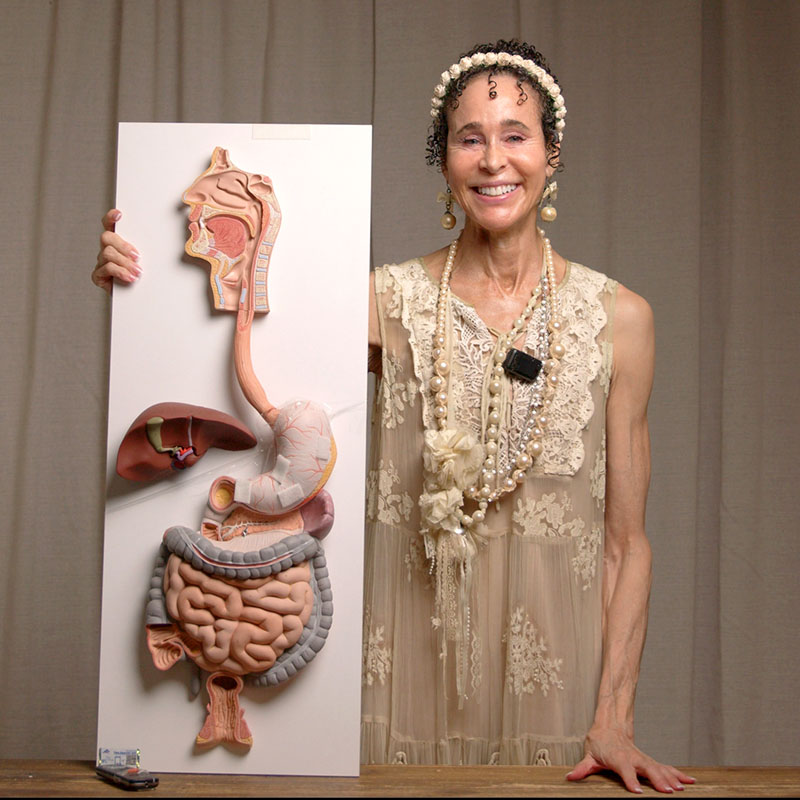
Transdermal hormones do not go in your mouth. They go on your skin, where the hormone is absorbed directly into your bloodstream. Therefore, they do not have to go through your digestive tract at all.
So, transdermal hormones do not affect your liver at all. This means that they don’t have the opportunity to pose an increased risk for blood clotting.
So, all oral sex hormones have a higher risk for blood clotting than all non-oral transdermal sex hormones.
The way in which your body utilizes oral versus transdermal hormones may differ based on several factors ranging from absorption to bodyweight to hormone metabolism. Regardless of your preference for one or the other, it may turn out that your body disagrees with you.
Some women discover that their body utilizes oral hormones better than it utilizes transdermal hormones. Other women discover that their body utilizes transdermal hormones better than it utilizes oral hormones.
The only opinion that matters is your body’s. The key to successful menopause management is to do what works best for you.
Over and over again, I speak with clients who, although they are unaware of the risk factors for blood clots, plan to make their menopause management decisions around this one single issue.
It makes absolutely no sense to design your menopause around a risk … unless it is a risk for you, personally. But, in most cases, menopausal women have just heard a soundbite about oral hormones and blood clots, and BAM! All of a sudden, that’s all that matters.
Menopause management doesn’t work well that way.
What works well is to know, firstly, the risk factors for any given problem. And then know whether or not you have those risk factors.
So that brings us to the risk factors for a blood clot. They are as follows:
So, the biggest risk in the whole world for a blood clot is pregnancy. And look at how many women endure pregnancy without a hitch. These are some of the very same women who think that they’re at high risk for a blood clot. But, their body has already proven to them (via pregnancy) that it doesn’t blink, even when facing the biggest risk for a blood clot.
Likewise, it doesn’t make sense to design your menopause management around avoiding a blood clot if you don’t have a genetic mutation for blood clot, have never had a previous blood clot, are not morbidly obese, are in no way immobile, and are a non-smoker.
Notice that a family history of somebody else having had a blood clot is not a risk factor for you having a blood clot.
It ONLY makes sense to design your menopause management around avoiding a risk if you actually have the risk factors.
First, you must designate your goals for menopause management. Then, consider your risk factors that pertain to menopause management. That way, you will always maximize your benefits and minimize your risks.
What you don’t want to do is fall short of your goals because you were managing your menopause around a risk that you don’t have.
Systemic estrogen is estrogen replacement made with little, tiny molecules that are small enough to get into your bloodstream and travel all over your body. Systemic estrogen decreases all your symptoms of estrogen deficiency and decreases your risk for all three diseases of estrogen deficiency … as long as your dosage is high enough to do so.
Because systemic estrogen travels throughout your body, it can increase your risk for a blood clot, if you have the risk factors for a blood clot.
Local vaginal estrogen is estrogen replacement made with huge molecules that are too big to get into your bloodstream. So they don’t travel anywhere. Local vaginal estrogen stays in your vagina and alleviates only your genital symptoms of menopause. It cannot alleviate any of your non-genital symptoms of menopause, and it cannot prevent any of the diseases of estrogen deficiency.
Because local vaginal estrogen does not travel throughout your body, it cannot increase your risk for a blood clot, even if you have risk factors for a blood clot.
Local vaginal estrogen is neither oral nor transdermal. It is available in the form of vaginal creams, vaginal inserts, and a vaginal ring called Estring. But all forms stay confined to your vagina.
Systemic estrogen is estrogen replacement made with little, tiny molecules that are small enough to get into your bloodstream and travel all over your body. Systemic estrogen decreases all your symptoms of estrogen deficiency and decreases your risk for all three diseases of estrogen deficiency … as long as your dosage is high enough to do so.
Because systemic estrogen travels throughout your body, it can increase your risk for a blood clot, if you have the risk factors for a blood clot.
Local vaginal estrogen is estrogen replacement made with huge molecules that are too big to get into your bloodstream. So they don’t travel anywhere. Local vaginal estrogen stays in your vagina and alleviates only your genital symptoms of menopause. It cannot alleviate any of your non-genital symptoms of menopause, and it cannot prevent any of the diseases of estrogen deficiency.
Because local vaginal estrogen does not travel throughout your body, it cannot increase your risk for a blood clot, even if you have risk factors for a blood clot.
Local vaginal estrogen is neither oral nor transdermal. It is available in the form of vaginal creams, vaginal inserts, and a vaginal ring called Estring. But all forms stay confined to your vagina.
In essence, if you’re a woman with zero risk factors for a blood clot, it doesn’t make a whole lot of sense to design all your menopause management decisions around a blood clot that you’re unlikely ever to have.
This is why I always make sure you know the risk factors for everything. That way, you can make all your decisions around your specific situation, knowing that you are making your decisions based on the things for which you are most at risk.
Yes, oral estrogen has a higher risk of blood clotting than transdermal estrogen. And oral progesterone has a higher risk of blood clotting than transdermal progesterone. Likewise, oral testosterone has a higher risk of blood clotting than transdermal testosterone.
But all of these risks are still low if you don’t have any of the risk factors for blood clotting.
I hope this serves to allay some of your fears and help you manage your menopause a little more freely. Just because you hear about blood clotting does not mean that YOU are at risk for blood clotting.

Hair loss during menopause is distressing. Here, I show you how to choose the right treatment so you don’t lose even more!
Don’t take “safer, more effective, natural, or synthetic” at face value. Here’s your homework!


Please try the following to resolve any errors:
1. Refresh your cache.
a. Web browsers store temporary files in a “cache” to speed up page loading. Refreshing your cache ensures you see the most recent and accurate version of a webpage. Instructions for Chrome and Safari (Windows and Mac OS) are as follows:
2. Use a different browser to open your questionnaire.
a. If you're experiencing an error while using Google Chrome, try opening your questionnaire on a different browser (Safari, Microsoft Edge, or Mozilla Firefox).
If neither of the above options works, please email clientsupport@menopausetaylor.me with the following:
1. A screen recording (preferable) or screenshot of the error
2. The browser and type of device you're using
a. This information will help us find and resolve the error.